Can a wallet make DeFi safer without taking control away from the user? That is the central question behind the growing interest in the Rabby Chrome extension and the wider Rabby Wallet ecosystem. Many people searching for “rabby wallet herunterladen” are not simply looking for another place to store tokens. They want a wallet that can handle Ethereum and numerous EVM networks, explain what a transaction is likely to do, and reduce the cognitive burden of switching between chains.
Rabby approaches that problem as a non-custodial interface and transaction-checking layer. It does not hold the user’s private keys, and it does not turn a risky smart contract into a safe one. Its value lies elsewhere: before signing, it combines simulations, warnings, network handling, and portfolio context to give the user more information at the moment when information matters most.
The first myth: a security warning is not a security guarantee
Rabby was developed by DeBank for DeFi users and is positioned as an alternative to MetaMask, particularly for people who interact with several decentralized applications and networks. Its security engine can scan contracts and addresses for signals associated with phishing, known hacks, and potentially dangerous approvals such as unlimited token allowances. These checks are useful because a transaction request often looks opaque to a normal browser user.
Yet the correct mental model is not “the wallet approves safe transactions.” It is “the wallet provides an additional screening and interpretation layer.” A scanner depends on the information available to it and on the way a contract behaves. A newly deployed malicious contract may not yet have a public risk history. A legitimate contract can still contain an exploitable bug. A familiar address can be compromised, impersonated, or reached through a misleading website. The warning system therefore improves decision quality; it does not replace the decision.
This distinction matters in Germany and across the wider European DeFi market, where users may reasonably expect software to provide clear risk information but should not confuse interface assistance with legal, financial, or technical assurance. The final signature remains the user’s authorization.
Why transaction simulation is more important than a longer chain list
Rabby’s most educational feature is its transaction simulation. Before the user signs, the wallet attempts to show the expected changes in token balances and other relevant effects. In practical terms, this can transform a vague prompt such as “Confirm” into a more concrete question: Which asset leaves my wallet? Which asset arrives? Is a token approval being granted? Does the outcome match the action I intended to perform?
The mechanism is valuable because smart-contract interactions are composable. A single dApp action can involve several contract calls, an approval, a swap, and a fee payment. The user may see only one button, while the underlying transaction has multiple consequences. Simulation exposes some of that hidden structure.
But simulation also has boundaries. It is an estimate of execution under particular conditions, not a time machine. Token prices can move, liquidity can change, block state can differ, and contracts may behave differently depending on timing or external data. A simulation that shows a favorable swap does not eliminate slippage, front-running, oracle risk, bridge risk, or contract risk. The practical rule is simple: treat the simulation as a pre-flight check, then inspect the destination, amount, approval scope, and network before signing.
This is the sharper insight: the strongest protection is not a wallet that makes choices invisible. It is a wallet that makes important choices visible enough for a user to reject them.
Rabby as a multi-chain operating layer
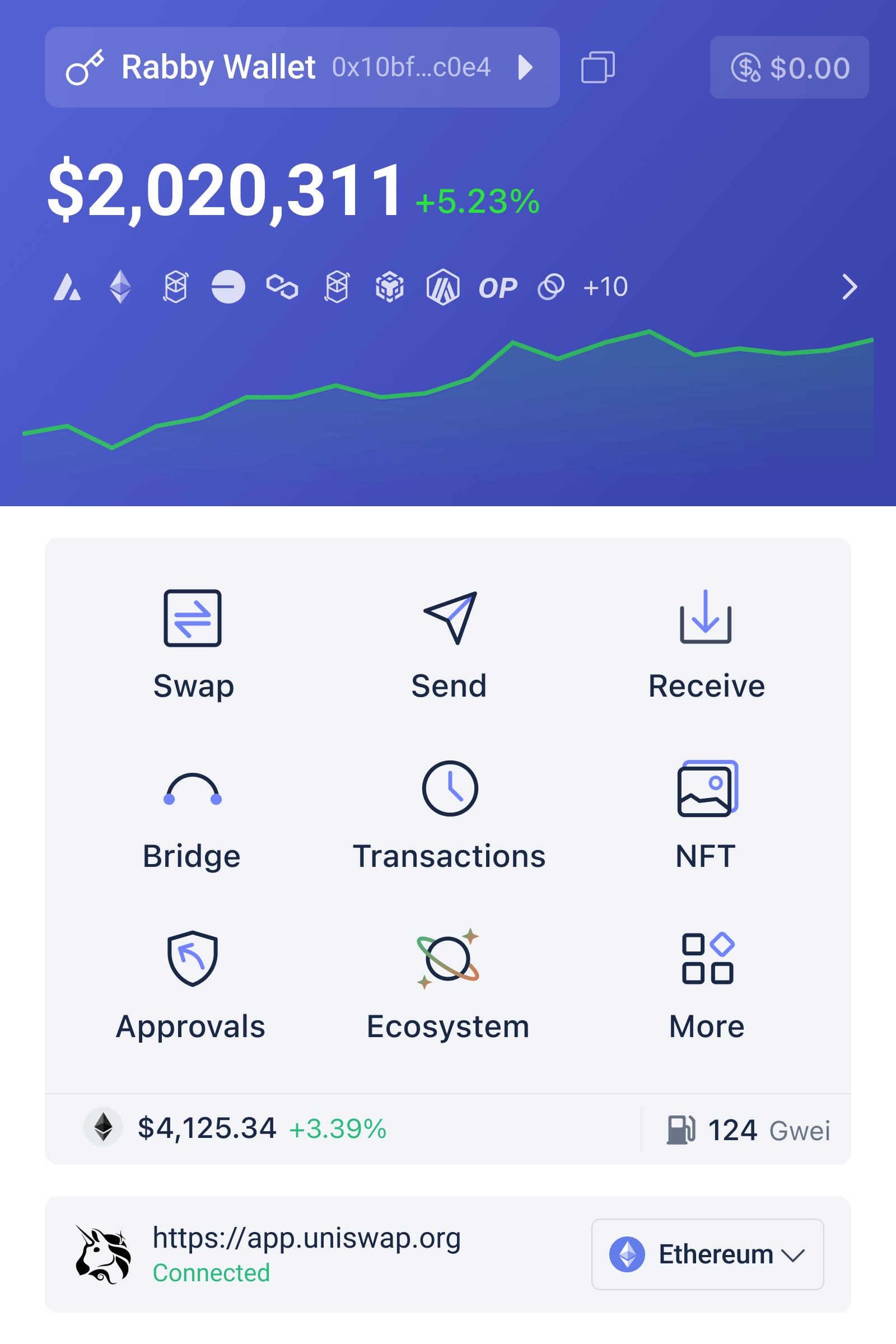
Rabby supports more than 140 EVM-compatible blockchains and networks, including Ethereum, Polygon, Arbitrum, Optimism, Avalanche, Base, and BNB Chain. It can also detect the network requested by a connected dApp and switch automatically. For a user who moves between Ethereum mainnet, a layer-2 network, and an app-specific environment, this reduces repetitive configuration and lowers the chance of interacting on the wrong chain.
Convenience, however, creates a new risk: users may stop noticing which network they are using. Automatic network switching is helpful when it removes friction, but it can hide an important economic fact. The same token symbol may represent different assets on different chains, and a balance visible in one network may not be spendable on another without a bridge or transfer.
Rabby integrates bridge routes such as LI.FI and offers swaps that scan decentralized exchange liquidity, including routes associated with Uniswap and 1inch. These functions can make the workflow more coherent: the user does not have to leave the wallet for every conversion or cross-chain transfer. Still, an aggregator optimizes among available routes; it cannot erase the risks of the protocols in those routes. A bridge introduces a distinct security and settlement surface, while a swap aggregator may present a competitive route that remains unsuitable if the user has misunderstood the token, chain, or approval.
Gas accounts, hardware wallets, and the real meaning of non-custody
The Gas Account feature addresses one of DeFi’s most irritating practical problems: the user owns stablecoins but lacks the native token required to pay network fees. By allowing fees to be paid across networks with stablecoins such as USDC, the feature can make smaller or occasional transactions easier. It is especially relevant for users who do not want to maintain a separate gas balance on every supported chain.
That convenience should be evaluated as a service dependency rather than as magic. Fee abstraction may involve routing, conversion, or other operational conditions, and users should still review the final cost and the asset being charged. “Paying gas in USDC” changes the user experience; it does not mean networks have stopped requiring their own execution economics.
For stronger key protection, Rabby works with hardware wallets such as Ledger, Trezor, and OneKey. This creates a useful separation: the browser interface can explain and prepare an action, while the signing key remains in a dedicated device. Even then, hardware wallets cannot protect a user who confirms a malicious transaction after ignoring its details. They protect key material, not judgment.
Rabby’s non-custodial design means private keys are stored locally on the user’s device rather than transmitted to Rabby’s servers. The software is open source under the MIT License, which supports independent inspection of the code. These are meaningful properties, but local storage shifts responsibility toward the user. A lost recovery phrase, malware-infected device, fake extension, or careless backup can still lead to irreversible loss.
How to approach a Rabby wallet download safely
The safest starting point is to obtain the extension or application through Rabby’s official distribution channels and verify that the publisher and installation context are correct. Search results and advertisements can imitate legitimate wallet pages, so the phrase “rabby chrome extension” should never be treated as proof of authenticity. Readers who want an orientation to the official wallet entry point can review the rabby wallet information page, then cross-check the installation against the project’s recognized channels.
During setup, the recovery phrase is the critical asset. It should never be entered into a website, sent to support, stored in an online note, or photographed casually. A wallet provider cannot restore a self-custodied account in the way a bank can restore online access. For meaningful holdings, a hardware wallet and a carefully considered backup process provide a stronger operational model than relying on a browser profile alone.
Before signing a first transaction, test the workflow with a small amount. Observe the selected chain, the contract address, the assets expected to change, the allowance requested, the gas cost, and the final recipient. This process is slower than blindly clicking through a dApp, but it builds a repeatable habit. In DeFi, a good habit often matters more than a good interface.
What to watch as Rabby evolves
Recent Chrome Web Store positioning describes Rabby as an open-source browser wallet for Ethereum and EVM networks, designed around a smooth multi-chain experience and protection for DeFi users. That direction is consistent with the broader product architecture: more chains, more integrated routes, and more contextual warnings.
The important question is whether added convenience improves comprehension or merely compresses more complexity into fewer clicks. Features such as Rabby Points, earned through activities including swaps, gas top-ups, or referrals, may encourage engagement. That does not make them inherently harmful, but users should keep incentives separate from security decisions. A reward for activity is not evidence that an action is economically sensible.
Looking ahead, the most useful signal will be how well the wallet communicates uncertainty. If simulations clearly distinguish expected effects from guarantees, and if warnings explain why an action is risky rather than merely displaying a red label, the interface can become a genuine educational tool. If complexity is hidden behind automation, the same convenience could encourage overconfidence. The outcome depends less on the number of supported chains than on whether users remain able to understand what they are authorizing.
Frequently asked questions
Is Rabby Wallet safer than MetaMask?
It is designed with a stronger emphasis on multi-chain DeFi workflows, transaction simulation, and contextual security warnings. That can improve usability and risk awareness, but no wallet can guarantee safety. The quality of the result still depends on the dApp, the contract, the device, and the user’s final approval.
Does Rabby Wallet store my private keys?
Rabby follows a non-custodial model in which private keys are stored locally on the user’s device and are not sent to Rabby’s servers. This preserves user control, while also making secure backups, device hygiene, and recovery-phrase protection essential.
Can transaction simulation detect every scam?
No. Simulation can reveal expected balance changes and may expose suspicious approvals or other warning signals, but it cannot prove that a contract is trustworthy. New attacks, changing blockchain state, bridge failures, and misleading interfaces remain outside any single automated check.
Rabby is best understood not as a shield placed between the user and DeFi, but as an inspection instrument. Its multi-chain support, simulations, security engine, hardware-wallet compatibility, swaps, bridges, and gas abstraction can make complex workflows more legible. The boundary is equally important: the wallet can improve the evidence available before a signature, but it cannot make an uninformed signature safe. For careful DeFi users, that is precisely the right promise to expect.